
Women in History Whose Husbands Locked Them Away, Even Though They Weren’t Insane
Part 1
One of the most notable of these women is Katherine of Aragon, the first wife of Henry VIII. Daughter of Queen Isabella and King Ferdinand of Spain, Katherine entered the world on December 16, 1485. She was the youngest daughter of the Spanish couple and was promised to Arthur, King Henry’s older brother at the age of 3. She arrived on British soil in 1501 when she was just 15. Isabella saw to it that Katherine’s education and early life suited a future Queen. Katherine studied Latin, Roman history, the bible and law under some of the best tutors in Europe. She was rumored to have been pious even from an early age. She had a strong devotion to the Catholic Church, which remained a beacon in her life and, sadly, helped lead to her demise in the future court of Henry VIII.
Like most genteel-bred ladies of her time, Katherine became skilled in embroidery, dancing, music and art. She was married to Arthur in November of 1501 and, what sounded like a fairy tale in the beginning, quickly turned to tragedy. The young Prince died of a mysterious illness just five months into their marriage.
Instead of returning to Spain, Katherine remained at the British Court, basically as a pawn between her Father-in-law, King Henry VII and her Father, King Ferdinand. The two constantly argued about her worth and her dowry. The thing at greatest stake was the question of Katherine’s virginity, because if she had lain with Arthur, she could no longer be considered as a wife of the royal British lineage. I am sure this was a great source of contention and grief for Katherine. Her virtue was publicly discussed and questioned until she confessed to the Bishop of Salisbury, Cardinal Lorenzo Campeggio that her first husband was too frail to consummate the marriage. In 1506, Pope Julius II granted a dispensation. Meaning that Katherine was again free to marry into the royal Tudor line.
First Wife of Henry VIII
Katherine was now 24, said to have been pretty at that time with fair, clear skin, blue eyes, and reddish-blond hair. Maybe that’s part of why Henry VIII became enamored with her before making her his bride in 1509. Henry was just two months into his 37-year reign. His Father had just passed, and with his late Father’s permission or not, which remains debatable, he finally made Katherine the official Queen of England.

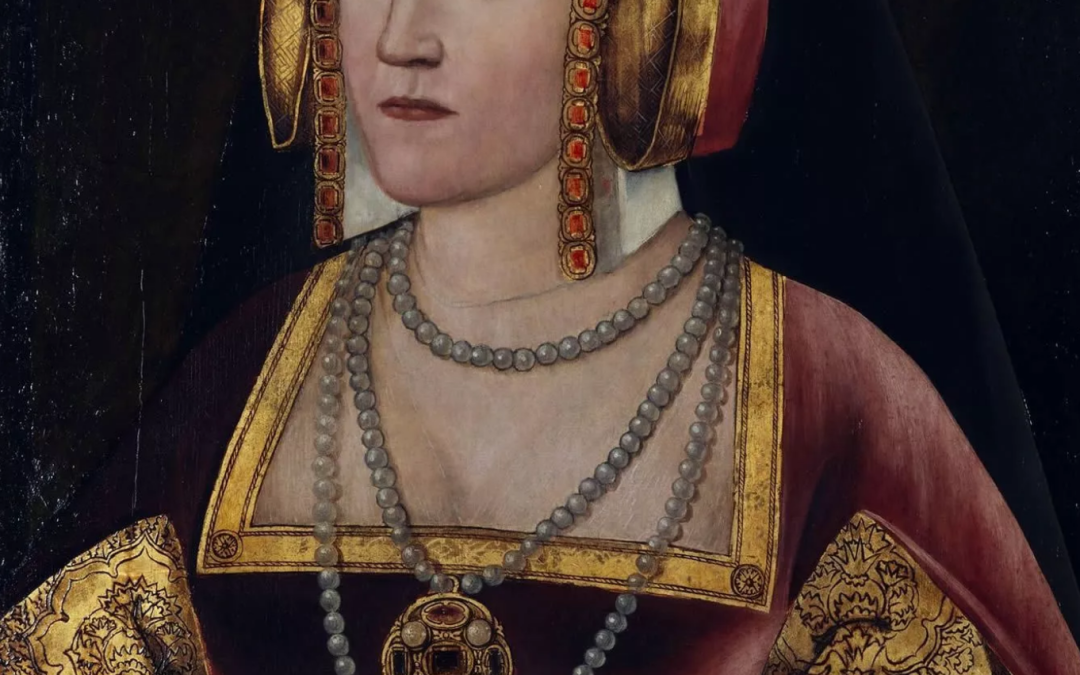
Catherine of Aragon as the Magdalene by Michel Sittow, c. 1468 – 1525 or 1526. Source: Public domain

Image from The Spanish Princess and Wolfhall
The greatest challenge of Katherine’s life, though and shared by most royal women of the time, was her inability to produce a male heir. Even though Katherine conceived six times, only one child survived: a girl, Mary. Formed mostly in her Mother’s care, Mary, who later went on to serve as Queen of England in her own right, was a disappointment to the monarchy and the lack of an heir grew to a point of dispensation ultimately leading to Katherine’s dismissal from court and imprisonment under strict house arrest at withering castles.
Many modern depictions show Mary becoming bitter and losing her youthful beauty as a result of these disappointments. One thing is true: as 5 years Henry’s senior, Mary wasn’t getting any younger and Henry’s eyes began to wander around the court.
The Meeting of Anne Boyelyn
As you may have heard, Henry’s next conquest, although difficult and taking place over a prolonged period of time, was the brown-eyed courtier Anne Boleyn. Anne came from a politically ambitious family and had spent time at the French court, where her Father, Thomas, was Ambassador. To the British Royals, Anne seemed foreign, was extremely intelligent and convinced Henry that she could give him the one thing that Katherine could not, a legitimate male heir.
A battle began among Henry, his well-trusted advisor and henchman, Thomas Cromwell (for a supremely well-written and witty depiction of Thomas Cromwell, I recommend you read Hillary Mantel’s Wolf Hall) <https://amzn.to/4qIL0HR>, Bishop Woolsley, Anne, and the Catholic Pope. During this time, Henry and his Aides fought for an annulment from Katherine, claiming that she had belonged to his deceased brother <Leviticus 20 v 21 >. The Vatican, meanwhile, was losing its grasp on England entirely as Henry and Anne embraced the growing wave of Protestantism in the Island Nation.

Wolf Hall Trilogy 3 Books Collection Set By Hilary Mantel (The Mirror and the Light [Hardcover], Wolf Hall, Bring Up the Bodies)

What Katherine must have been thinking at this time is not well documented. What we do know is that, in the beginning, she saw Henry’s flirtations with Anne as just another woman in a series of unofficial mistresses. Katherine, composing herself as a gracious Queen, kept Anne in her company of ladies, only remarking famously, as depicted by the poet George Wyatt, “My lady Anne, you have good hap to stop at a king, but you are not like others, you will have all or none”. (The Anne Boleyn Files)
Therefore, Katherine didn’t begin to take the romance between Henry and Anne seriously until word reached her that Henry was secretly requesting an annulment from Pope VII. Katherine and Henry had been married for 24 years at this time and Queen, or not, it landed as a devastating betrayal that most women would not have taken lightly. Katherine wrote to her nephew, the Holy Roman Emperor Charles, pleading with him to intervene. The dispute went on for a couple of years until Henry finally got his way in 1533, two years after having officially banned Katherine of Aragon from court. As soon as she left court, in fact, her rooms were redecorated and given over to Anne Boyelyn promptly.
Katherine of Aragon Imprisoned Wife of Henry VII
So, what happened to Katherine? The two best-known places Katherine was farmed out to were Buckden Palace in Cambridgeshire, north of London, and Kimbolt Castle, where she died in 1536, just three years after Henry and Anne’s official marriage.
Buckden Towers, as it came to be known, was built in the 13th century as a stopping place for Bishops traveling for church business between London and Lincolnshire. The grounds, protected by a moat, contained a courtyard, a chapel, Tower House, where the Queen resided and a great chamber which became a place of significance in one of Katherine’s last great stands against the King.
Katherine’s complaints about the awful conditions at Buckden Towers, which were built on the edge of the Cambridgeshire Fens, which were marshland at the time, were echoed by her confidant and long-time ambassador to England from Spain, Chapuys. (As a true diplomat, Chapuys played both sides.) The Duke had been ‘commissioned to bring the queen by force to a house surrounded with deep water and marshes, which is…the most unhealthy and pestilential house in England,’ he wrote in a letter on December 23, 1533.

Looking toward the Tower at Buckden from across the garden (once part of a moat). The Tower contained the principal private apartments during the Tudor period.
Image © The Tudor Travel Guide
The Final Years of Katherine of Aragon
For Katherine’s part, she didn’t go down without a fight. When the Duke of Suffolk, Charles Brandon, King Henry’s long-time friend, arrived to inform her that she was no longer the Queen of England but instead the Dowager Princess, she locked herself in the Tower, where she refused to concede the title or the legitimacy of her daughter Mary. As a result, she was stripped of many servants, saying that ‘she would not have any others, and would sleep in her clothes, and lock the gate herself.’
Most of Katherine’s time at Buckden was filled with melancholy according to accounts from contemporary peers. Not only had she become physically frail with a nagging cough, she spent most days in solitude at church or in prayer. She had taken Fransiscan Orders which led to her wearing a habit and spending quiet lonely days without much exercise.
In May of 1954 Katherine was relocated to Kimbolt Castle, originally built in the late 12th century, but by the 1500s was little more than manor houses surrounded by an overgrown grassy moat. It was written that, “by occasion of the old maintill [mantle] wall, the hall there well builded is likely to perish; and through the said castle is and will be great decay, by occasion there is no reparations done.”
So it was in this state that Katherine greeted her death in January 1556 at the age of 51. Born the Spanish Infanta, having been married to two English Kings and given birth to Mary, who, unknown to her, would become a British Queen, Katherine died in her Chambers with few people in attendance. She dictated a letter of final wishes to Henry and let her flame go out, saying that, ‘she would in no wise have any other physician but only commit herself to the pleasure of God.’